Ionite
The Last JediIonite is a substance with the unusual ability to cancel either a negative or a positive charge, making it useful both as a component in resistance weaponry and as a means of disrupting Imperial technology. In the events surrounding the Far Ranger’s journey along the Hydian Way, it is not merely valuable cargo: it is also the basis of contact between scattered resistance groups and a material component in a device that conceals sensitive conversation by fabricating harmless trade talk.
Properties and Resistance Uses
Ionite’s defining property is its response to the charge presented to it: it cancels that charge whether positive or negative. This makes the substance useful against equipment whose operation depends on an electrical charge. In particular, it can defeat shield generators and communications grids, and it has also proved effective as a component in weaponry. Those applications explain why the resistance considers it valuable: ionite can interfere with both the protection and the coordination on which Imperial operations rely.
The substance’s usefulness is practical rather than limited to a single specialized device. Its charge-canceling effect offers a way to counter different systems, while its use in weapons gives it a further role in resistance efforts. The cargo therefore carries strategic importance beyond its appearance as ore or ingots. The quantity matters as well: the Far Ranger ultimately carries enough ionite to meet the needs of its allies on Toprawa, and the possibility of trading some of it becomes the foundation for a local arrangement.
A Discreet Supply Route
The Far Ranger’s route was designed to make its movements seem ordinary. On the Hydian Way, the ship could present itself as one more freighter making routine port calls rather than as a vessel carrying subversives. The plan was to stop at Bandomeer, make brief contact with the new resistance cell there, and then continue through Botajef, Celanon, and Feriae Junction before reaching Toprawa and contacting the surviving Antarian Rangers. The repeated commercial stops served as cover for the political purpose of the journey.
At Bandomeer, the presence of the Galactic Empire and one or two Imperial Inquisitors meant that Jax Pavan and Laranth Tarak stayed aboard the Far Ranger in dormancy. I-Five and Den Dhur instead performed the public-facing work of bartering for ionite. Their apparent trade activity also enabled them to contact members of the local Whiplash organization and exchange information. Ionite thus figured in two kinds of exchange at the stop: it was a material the crew sought, and the ordinary business of acquiring it helped make resistance contact possible without openly exposing the ship’s purpose.
After loading ore and ingots, the Far Ranger continued along the Hydian Way and made several further port calls. It reached Toprawa ten days after leaving Coruscant, carrying enough ionite for the needs of its allies there. The cargo’s passage depended on the same contrast that shaped the route: an apparently mundane commercial voyage concealed the movement of a resource intended to frustrate Imperial power.
The Toprawa Arrangement
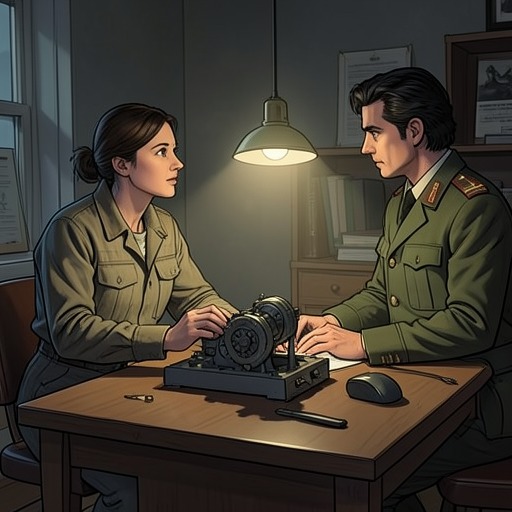
At Toprawa, Jax Pavan and Laranth Tarak met Aren Folee to discuss confidentiality and the possibility of a trade. Aren Folee wore a medallion on a thick metal torque. When she activated it, the device ensured that anyone snooping on the conversation would receive fabricated, deadly boring trade dialogue built from material in the real discussion. The speakers still needed to supply enough innocuous conversation to give that dialogue generator fuel, so the protection did not mean that they could speak without restraint.
The medallion’s circuitry used ionite. Rather than simply jamming surveillance signals, it fed eavesdroppers a constructed version of the conversation, screened to exclude programmed hot words and phrases. From a surveillance system’s perspective, no jamming was occurring. The design makes ionite’s role here distinct from its use against shields and communications grids: its properties contribute to a deception system that turns overheard speech into misleadingly ordinary trade talk.
Laranth pointed out that the Far Ranger carried enough ionite to gum up a shipload of surveillance snoops and proposed providing some in exchange for one of Aren Folee’s medallions. The request made the local device itself part of the negotiation: the crew wanted not only to distribute their cargo but also to bring home the technology it enabled. After food and drink arrived, the parties made a show of consuming them before settling back into discussion. They arranged to off-load as much ionite as their allies on Toprawa could use. When Aren Folee asked whether the travelers expected to return that way, Jax said they had planned a more direct route back to Imperial Center.
Strategic Significance
Ionite connects the Far Ranger’s ostensibly commercial journey with the resistance’s need for equipment, information, and secure communication. Its charge-canceling property gives it a direct use against Imperial defenses and infrastructure; its value in weaponry broadens its military application; and ionite circuitry makes possible a system that disguises surveillance targets rather than announcing that it has defeated surveillance. These functions are related by the material’s practical capacity to interfere with systems the Empire depends on, but they remain distinct uses of the substance.
The Toprawa exchange also shows that the resource’s value can travel in both directions. The resistance can receive ionite for its needs, while the crew can seek a medallion whose technology they want to use at home. The conversation is protected not by silence but by a controlled excess of innocuous speech, and the ionite-bearing ship is concealed not by avoiding ports but by making its route look like routine freight business. In this way, ionite serves as cargo, technological material, and the basis of a reciprocal arrangement between resistance allies.